
Power Pumping:
Does It Really Boost Milk Supply?

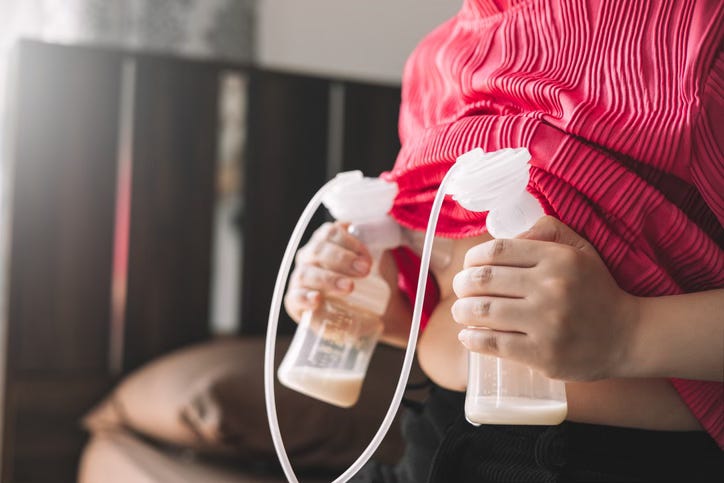
Low milk supply is a common concern raised by breastfeeding parents, particularly those who are attempting to establish and maintain milk supply with a breast pump. In response, many are advised to add “power pumping,” to their routine pumping schedule.
But what exactly is power pumping—and what does the research actually say?
What is Power Pumping?
Power pumping is a pumping strategy designed to mimic infant cluster feeding, a normal behavior in which babies feed frequently in short bursts. The increased stimulation at the breast is thought to signal the body to produce more milk through hormonal pathways, particularly the release of prolactin.
Instead of pumping once for 15-20 minutes, power pumping typically follows a pattern such as:
Pump 20 minutes
Rest 10 minutes
Pump 10 minutes
Rest 10 minutes
Pump 10 minutes
This pattern is typically recommended once daily for several days, while maintaining the usual feeding or pumping schedule.
The idea is simple: increased stimulation signals higher demand, which increase supply.
Why the Theory Makes Sense
Human milk production operates on a supply-and-demand system. When milk is removed frequently and the breast is fully drained, the body responds by producing more milk. This is the biological mechanism thought to be behind cluster feeding. During cluster feeding, babies may feed every 20–60 minutes for several hours. Power pumping attempts to recreate that signal using a breast pump.
What Does the Research Show?
Despite its popularity, power pumping has surprisingly little high-quality research behind it.
In a small randomized pilot trial studied 78 mothers of very low birth weight infants with low milk output who were assigned to either power pumping or routine pumping, researchers found:
Milk volume during individual pumping sessions was significantly higher in the power pumping group on day 6 & 7
Median volume expressed was 50 mL vs 27 mL in the routine pumping group on day 6 & 7
The median milk volume pumped cumulatively during power pumping over 7 days was also significantly higher
While this appears promising at first glance, a deeper look at the study is important. The mothers in this study were hand expressing every 3 hours and adding only one pumping session per day. Both groups were using a double electric breast pump with the control group pumping for 10-15 minutes and the intervention group using a power pumping session, once a day. So does this mean power pumping itself was the determining factor in the higher volume? Or, was is just that the total number of times pumped by the intervention group was 3 vs. the control group who only pumped once per day? While this intervention did take place in a large tertiary care center, the hand expression protocol is not common for US moms, which makes it difficult to compare with our current common pumping practices in the NICU setting. This was a small pilot study, and larger trials are still needed to determine whether power pumping truly improves milk volume in a sustainable way.
What Lactation Physiology Suggests
Even without robust clinical trials, the physiology behind power pumping does align with established lactation principles:
Frequent milk removal stimulates prolactin secretion
Breast emptying increases milk synthesis
More frequent stimulation signals higher infant demand
Although there is not a strong body of evidence to support power pumping, the fact that it aligns with accepted principles suggests that it is probably a safe tool to apply in certain situations.
When Power Pumping May Be Helpful:
Building milk supply during exclusive pumping
Attempting to increase supply after a temporary drop
Supporting milk production when a baby cannot feed effectively at the breast
Pump-dependent situations (NICU, separation, return to work)
If power pumping is working, moms should see improvement in overall supply in 7 days, though results vary widely. If no improvement is realized, or if the power pumping sessions feel overwhelming or uncomfortable to mom, the intervention should be discontinued.
When It Is Not Likely to Be Helpful:
Milk supply is already adequate (risk of creating an oversupply)
The issue is ineffective milk removal
The underlying problem is hormonal or medical
Practical Takeaways:
We know that there are established methods to supporting milk supply, and these should be “first-line,” tools in counseling breastfeeding families.
Evidence-supported approaches to increasing milk production include:
Frequent milk removal
Effective breast emptying
Combining hand expression with pumping
Skin-to-skin contact
Addressing latch or pumping mechanics
Although the number of pumping sessions are important, we also should be cognizant of the fact that “pumping,” does not always equate with adequate milk removal. Before making a blanket recommendation to increase pumping, at least one pumping session should be observed to assess proper use of pump, appropriate flange sizes and overall pumping adequacy. Power pumping may help temporarily increase output, but it will likely work best when combined with these fundamentals.
Bottom Line
Power pumping is widely recommended in breastfeeding communities but strong evidence demonstrating long-term improvements in breastfeeding outcomes is still limited. Like many lactation strategies, its effectiveness likely depends on the underlying cause of low milk supply.
Most importantly for parents feeling discouraged by supply concerns, individualized lactation support remains the most effective intervention.
Kalathingal T, Manerkar S, Mondkar J, et al. Comparison of two pumping strategies to improve exclusive breastfeeding at discharge in mothers of VLBW infants with low milk output: a pilot randomized controlled trial. Indian J Pediatr. 2024;91(9):906-912. doi:10.1007/s12098-023-04859-4. PMID:37794310.
D’Hollander CJ, McCredie VA, Uleryk EM, et al. Breastfeeding support provided by lactation consultants: a systematic review and meta-analysis. JAMA Pediatr. 2025;179(5):508-520. doi:10.1001/jamapediatrics.2024.6810.